Our Journey Through Mongolia: A Traveler’s Story
It’s hard to imagine that a trip to a local Mongolian Barbecue would inspire a part of my honeymoon. As my wife Jacki and I planned our trip around the world, we plotted points on the globe and realized we had a gap in Asia. It was then that she reminded me of my long-standing fascination with Mongolia.
Almost 20 years ago, as I made plans to meet a friend at a Mongolian barbecue restaurant, I learned they had a location in Ulaanbaatar. This led me down an evening-long rabbit hole about Mongolia’s history, its people, and its culture. From that moment, any mention of Mongolia in the news piqued my interest.
Jacki and I landed at 2am, and as we waited for our bags, she couldn’t help but laugh at the dichotomy in front of her – dozens of half-awake travelers eager to get home, and me, with a massive grin, exclaiming “We’re in Mongolia, baby!!!”
We walked out of customs to be greeted by the Nomadic Expeditions team, and Oochir, our guide for the week.
We spent roughly three days apiece in Ulaanbaatar and the Gobi Desert, a perfect mix of modern Mongolian life and the solitude and serenity that make the country famous.
In the city, we learned about Mongolian history, stretching back to the clans that ran Mongolia prior to the 13th century, straight through its modern democratic transition in the 1990s. And we saw dinosaurs – lots of them. Mongolia is home to some of the best paleontological sites in the world, to the extent that one of the local malls had a full Tarbosaurus skeleton on display.
The highlight of Ulaanbaatar was the equestrian statue of Chinggis Khan. Even as modern Mongolia moves forward, Temujin’s life remains its greatest story. The young man rose from an outcast rescuing his wife, to a visionary who saw uniting the steppe as the only path to long-term peace. The statue is immaculate, glowing a shade of silver and standing at about 40 meters and near a national park. It’s also a nod to his legacy, standing on the spot where legend tells us he found the golden whip that led him to victory in battle.
From there, we headed to the Gobi and the natural world. The emptiness of the Gobi is hard to describe. As we left Dalanzadgad for Three Camel Lodge, there were no roads – just tracks from other vehicles. The driver headed in the general direction, following landmarks that only he knew. Over the whole drive we saw one road sign, which had just an exclamation point. In the desert, we saw traditional dancing, met local families, and played games like archery and shagai tuuh. And we saw some amazing sights – the massive 1,000-foot dunes at Khongoryn Els, petroglyphs from 5,000 BC, and a hike through Yol Valley National Park.
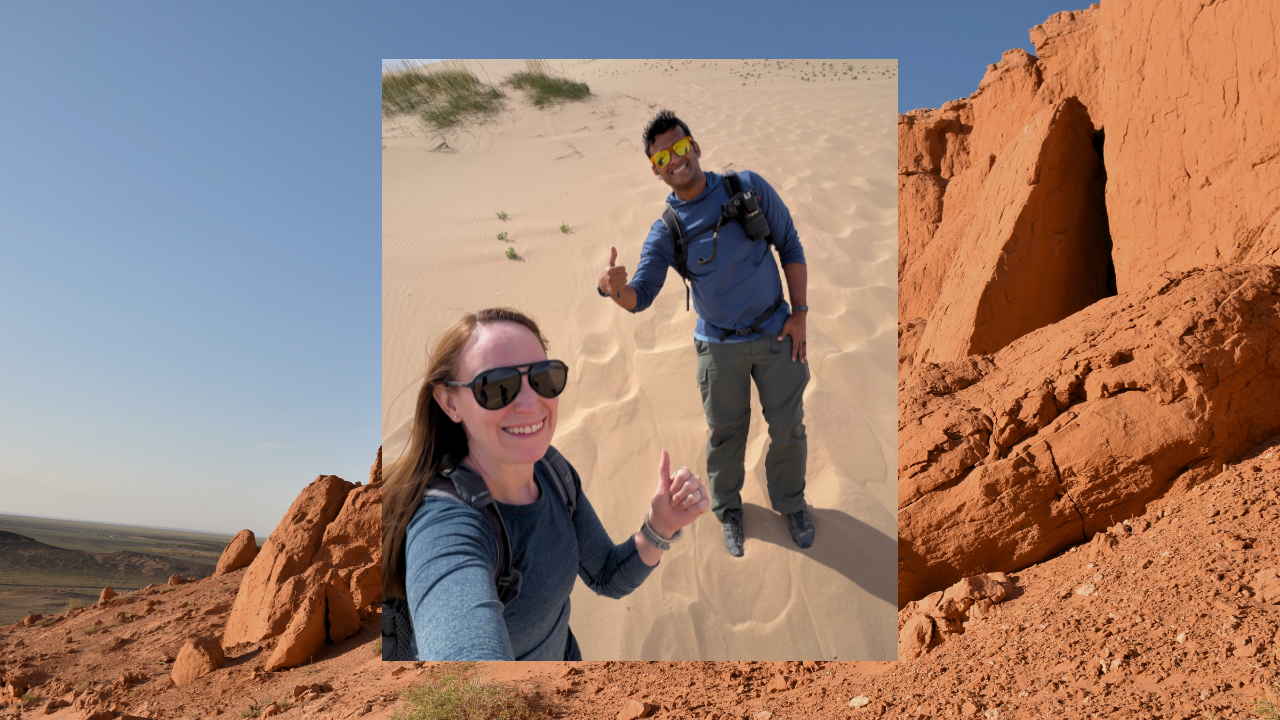
The most memorable moment was sunset at Bayanzag (the Flaming Cliffs). Looking back, the feeling of sipping wine with Jacki, watching the light reflect off the glowing red soil, makes me smile. Jacki names this her favorite moment, though she says my 2am airport grin is a close second.
Of everything we experienced, one thing stands out most – the people. Mongolia is special because it’s distinctly its own place: the culture, the language, the history. While its neighbors’ influences are obvious, it was remarkable to see everyday life unfold: children yelling “Hello!” to us as we yelled back, “Sain uu!” in our broken Mongolian. On the last night, Jacki and I walked around the amusement park near the central square and it was full of school children waiting for different rides, with not an adult in sight. I wondered whether I’d ever see that back in Chicago.
Of course, I also learned that Mongolian barbecue has no connection to Mongolia. This is why we travel the world.