The United Nations Educational, Scientific and Cultural Organization (UNESCO) promotes the protection and preservation of cultural and natural heritage around the world that is considered to be of outstanding value to humanity. A UNESCO World Heritage Site is officially recognized for its cultural, historical, scientific, or natural significance and is protected through international cooperation and shared legal frameworks.
Mongolia is home to six UNESCO World Heritage Sites, with an additional twelve sites on the Tentative List. Ranging from relatively small monument sites to vast tracts of natural landscape, these places embody Mongolia’s heritage as our legacy and key to our past, and they are cultural and natural sources of life and inspiration that must be passed on to future generations.
Their inscription has given the following locations international recognition, attracting historians and researchers as well as travelers drawn to Mongolia’s distinctly different regions to experience their significance.

Orkhon Valley
This cultural landscape is located along the banks of the Orkhon River and stretches 320 km, covering 121,967 hectares of land across multiple counties of the Arkhangai and Uvurkhangai provinces. The Orkhon Valley represents the nomadic way of life, which has been evolving for more than 2,000 years. A magnificent historical site with archeological, historical, and cultural monuments—it bears evidence of the origins of the nomadic civilizations of Central Asia, including the Mongols, the major centers and nations that developed here—as well as settlements of the ancient stone, bronze, and Iron Age Moilt peoples. Monuments and ruins here include the famous mausoleums of Turkic kings; the ruins of Khar Balgas, the capital of the Uighur Empire; Kharkhorum, the capital of the Mongol Empire founded by Genghis Khan; Erdene Zuu, the center of Buddhism in Mongolia; and Xiongnu, one of the capital ruins found in Ulziit county of the Arkhangai province. And here you will find the grassland still grazed by Mongolian nomadic pastoralists.

Mongolian Altai Petroglyphic Complexes
Composed of ancient rock carvings and funeral monuments that are as old as 12,000 BC and provide complete documentation of the interaction between prehistoric North Asians and their environment, the Mongol Altai Rock Art Complex is one of the largest ancient art galleries not only in Mongolia but also in the world. Unique in that the petroglyphs depict many periods in the history of human development, the earliest paintings show valleys and dense forests where large deer are hunted. Later paintings show the beginning of a herding lifestyle, while paintings from the Xiongnu (1st century BC) and Turkic (7th-8th centuries AD) periods illustrate a transition from horses to a nomadic lifestyle. These rock carvings are a priceless contribution to the study of the origins of many nations and ethnic groups that have lived in Central and North Asia since recorded time.

Deer Stone Monuments
Inscribed on the UNESCO World Heritage List in 2023, the Deer Stone Monuments and Related Bronze Age Sites represent one of Mongolia’s most distinctive archaeological landscapes. Dating from approximately 1200 to 600 BCE, these carved standing stones are found primarily in central and northern Mongolia, often set within ceremonial complexes that include khirgisüür burial mounds and ritual structures. Together, they reflect the spiritual and social systems of early nomadic pastoral societies.
The stones are engraved with stylized deer and symbolic motifs that are widely interpreted as expressions of cosmological belief, ritual practice, and commemoration. With more than eighty percent of the world’s known deer stones located in Mongolia, the site underscores the country’s central role in the development of Bronze Age steppe cultures and preserves one of Eurasia’s most significant traditions of prehistoric monumental art.
Great Burkhan Khaldun Mountains
Part of the Khan Khentii Strictly Protected area, this is considered the most sacred mountain in Mongolia as it was designated so by Chinggis Khan, who is also believed to have been born and buried there. Mount Burkhan Khaldun is one of the mountains that have been worshiped and protected since the time of Chinggis Khan. Burkhan Khaldun is associated with Mongolia’s worship of sacred mountains, rivers and ovoo-s (shamanic rock cairns), in which ceremonies have been shaped by a fusion of ancient shamanic and Buddhist practices. The first known laws to safeguard the environment in Mongolia were set by Chinggis Khan, who mandated the preservation of nature through rational use of land, water, and pasture—which to this day has successfully protected vast undisturbed natural habitats that support many wild species.
Uvs Nuur Basin
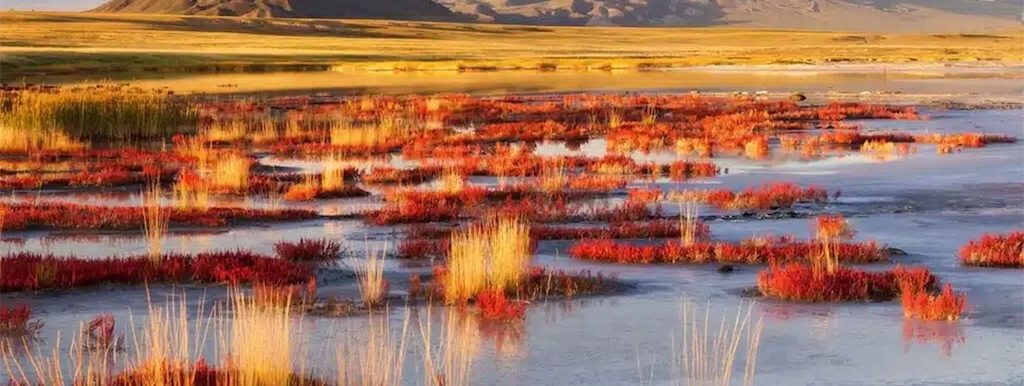
Taking its name from Uvs Nuur Lake—a large, shallow and very saline lake important for migrating birds, waterfowl, and seabirds—this State Nature Biosphere Reserve is one of the enclosed basins of Central Asia. The basin is home to a rich biodiversity of flora and fauna including the endangered snow leopard, mountain sheep, the Asian ibex, and the marbled polecat. The basin contains more than 40,000 archaeological sites linked to ancient nomadic tribes and peoples including the Turks, Huns, and Scythians.
Landscapes of Dauria
Shared between Mongolia and the Russian Federation, this landscape is an outstanding example of the Daurian Steppe eco-region, covering 912,624 hectares, of which 279,023 hectares are in Russia and 633,601 hectares are in Mongolia’s Gurvanzagal, Dashbalbar, Chuluunkhoroot, and Bayandun soum of Dornod provinces. Cyclical climate changes with distinct dry and wet periods lead to a wide diversity of species and ecosystems here that are of global significance. The different types of steppe represented–such as grassland and forest, as well as lakes and wetlands—serve as habitats for rare species of fauna, such as the White-naped crane and the Great Bustard, as well as millions of vulnerable, endangered, or threatened migratory birds. It is also a critical site on the migration path for the Mongolian gazelle.